Saturday, March 10, 2018

The retreat of liberalism goes on


As communism seemingly disappeared from view at the end of the 1980s, in a sudden and unexpected blow-out, there was plenty of triumphalism around in the west.  The most infamous was perhaps that of Francis Fukuyama, a US state department career man turned historian.  He got his publishing break with a book called “The End of History and the Last Man”.  The end of communism, he suggested, meant that man’s ideological evolution, the very stuff of history, was over. Western liberalism had won.  Nothing seemed to appear on the horizon to challenge its by then unquestioned dominance.

Francis Fukuyama has continued to publish books on the history he thought had ended but his original thesis looks more and more messy the further away we get from the 1990s.
Here we are in March 2018 and the retreat of liberalism is pretty much full-on.  The authoritarian march of Putin and Xi is matched by their less consequential peers and puppets, men such as Erdogan in Turkey, Assad in Syria, Maduro in Venezuelas.   Meanwhile, the challenge from within continues, as liberalism is broadsided in its own realms by such as President Donald Trump, Hungary’s Victor Orban, Poland’s Morawiecki and the onslaught of populist parties like Five Star in Italy or AFD in Germany. 

The problem of liberalism is further exacerbated by the feebleness of its defending leaders.  Angela Merkel has been holed beneath the political waterline by her poor election showing last November, and the 5 months it has taken since to establish a workable government.  Britain’s Theresa May is wholly occupied in withdrawing her country from the last great international liberal project, the European Union.  As she does so, her supporters attack both the courts and those elected MPs who disagree with their hard Brexit ideology.  Only President Macron of France and Prime Minister Trudeau of Canada seem to be charismatically manning the bridges in defence of liberalism, and Trudeau suffered a set-back with a ludicrous recent tour of India that exposed him more to ridicule than respect. 

As liberalism struggles to assert itself, the vacuum it is leaving becomes all too readily apparent.  Nothing this week has been so redolent of the enfeebled nature of a liberal state than Britain’s position as the recipient of a chemical attack by Russia.  You can hear the suppressed, gleeful laughter in the Kremlin even as Putin and his acolytes seek to po-facedly deny any links to the attack by nerve agents on former Russian spy Sergei Skripal and his daughter Yulia.

Over in Syria the misery of Eastern Ghouta is testament to the consequences of America’s abandonment of its role as liberal guardian.

The wanton destruction of Yemen stands as witness to the removal of restraint by any liberal leadership over the one time client states of the middle east.

In Italy the people vote for parties led by clowns, one a former artist of the genre and another the corrupt, criminal buffoon who brought clowning into the prime minister’s office; the rise of both a stunning rebuff to liberalism and its leaders.

While liberalism retreats the dictators stand triumphant, and the laughter of Donald Trump as he admires the right to rule for life acquired by China’s Xi Jinping is the maniacal noise of the inmate who has finally stolen the keys to the asylum.

If as Fukuyama suggested the triumph of liberalism represented the evolutionary end point of mankind’s ideological and political journey, then the species has apparently managed to find a post-evolutionary slope to speed down afterwards. 

Friday, March 09, 2018

Trump's More Than Lewinsky Moment

It's always a busy time for the Donald.  Today alone he is defending his new tariff system and agreeing to meet North Korean dictator Kim Jong-Un, where they will engage in personal diplomacy since Trump hasn't actually got any advisers who know anything about North Korea.

Despite the shrill insistency of news about Trump, it appears there is still space for porn star Stormy Daniels to keep popping up.  This is the person who Trump's lawyer allegedly paid $130,000 to in order to stop her revealing her liaison with Trump at the height of the 2016 election.

Republicans and evangelicals, once the very embodiment of moral outrage over Bill Clinton's tawdry affairs, have now accustomed themselves to the ways of the world.  This piece from Eugene Robinson on Real Clear Politics is a clear summary of the Daniels affair, and concludes with this robust, scathing and on point analysis:

"The personal lawyer of the president of the United States, days before the election, paid $130,000 to apparently buy the silence of a porn star. Said porn star credibly describes an affair she had with the president and the ham-fisted attempts by his lawyer to keep her from talking about it. All of this unquestionably speaks volumes about the president's character and morals.
Republicans who regarded Bill Clinton's affair with Monica Lewinsky as the end of civilization as we know it are serenely untroubled. Evangelicals who rail against sin and cloak themselves in piety offer nothing but a worldly, almost Gallic shrug. Daniels has taught us much about their character and morals, too."

Thursday, March 01, 2018

Amidst the turmoil, Trump can count major successes

From Dan Balz in the Washington Post today, this assessment of the credit side of President Trump's ledger makes for encouraging reading if you're a conservative, and should give you pause for thought if you're a liberal who thought that Trump's bizarre, maverick style might spell his doom:

"That’s not to say the president hasn’t had successes or made progress in changing the course of policy in the aftermath of the administration of President Barack Obama. He signed a huge tax cut. The economy is in good shape, unemployment is at a low level, and the stock market, despite some recent downs and ups, is well above what it was when he came into office.
He has changed the enforcement of immigration laws, as he promised during the campaign. He has softened or reduced regulations on businesses. He has facilitated a conservative shift in the makeup of the federal judiciary. He has pulled the United States out of the Paris climate agreement and sought to shift U.S. trade policy away from the free-trade consensus of past administrations.
President Trump attends a bipartisan meeting Wednesday with members of Congress to discuss gun control and school and community safety in the Cabinet Room of the White House. (Jahi Chikwendiu/The Washington Post)
Those changes cannot be underestimated, and to the degree that he has been stymied or unsuccessful elsewhere, many of his supporters blame the Democrats, congressional Republicans or the federal bureaucracy, a.k.a. the deep state. The core of his support remains intact, and he is the most popular person in his party by a mile."

Sunday, February 25, 2018

Who's voting,for whom and where? US election analysis talk

The next concrete vote on Trump isn't until November, but pollsters and election wonks are all analysing the data furiously to see if the Democrats will ride a wave back to congressional power, or whether Trump and the Republicans will in fact be able to dig down further and secure a counter-cycle triumph.

This election analysis and discussion from Politico is fascinating and a must read for students of American politics.


Friday, February 23, 2018

Shooting Schoolkids and mis-using the Second Amendment

The wording of the famous Second Amendment to the US Constitution is this:

"A well regulated militia, being necessary to the security of a free state, the right of the people to keep and bear arms, shall not be infringed".

My students and I saw it just a few days ago, the faded writing on the Bill of Rights displayed in the National Archives still visible. I was puzzled for a while, as in the document this is actually the fourth amendment, but it turns out the first two weren't ratified, thus pushing the famous arms amendment up to number 2 in the ranks.

I've read it a number of times, and it still seems to me that the so-called right to bear arms is very dependent on the maintenance of a militia to defend the state.  It is not, thus, an individual right at all.  It is very much a concession granted in the interests of state defence.

So how has this seemingly obvious interpretation become so sullied that the second amendment now becomes synonymous with individual freedom and democracy?  So ingrained into the American psyche as a key element of freedom that no matter how many kids are shot in schools, the right to buy any type of weapon for individual use can never be controlled?

It turns out this is a recent phenomenon.  And it's down to an organisation called the National Rifle Association, itself the front group for gun manufacturers.

As early as 1876 the Supreme Court ruled that the Second Amendment was not a granting of the right to bear arms (United States v Cruickshank).  A 1939 ruling (US v Miller) maintained the link between arms and a militia.  Only more recently has the Second Amendment been given such broad latitude as to imply a defence of the individual right to bear arms, most noticeably in the 2008 District of Columbia v Heller ruling.

It beats me how the so-called "originalists" - the right-wing judges who claim to adhere to the very wording of the constitution and its amendments - can possibly interpret the 2nd in any other way than the one written above - as the need to preserve a "well regulated" militia.  They say the commas should be ignored and that the two clauses, on militia and the right to bear arms, are not really linked.  Doesn't read that way at all, so I guess originalists are more like creativists after all.  Which is just one of the many tragic ironies of the gun control debate in America.

The NRA's chief, Wayne LaPierre, has given an uncompromising defence of arms in the wake of the Florida school killings, at the CPAC conference.  He trotted out the old line that all you need to stop bad men with guns is good men with guns.  Do lots of "good men" hold guns?  Would "good men" want to be always ready to shoot to kill I wonder?

The NRA has been so successful in its defence of the right to have guns - and thus the immediate use of a lethal killing machine right by your side as and when you want it - that it has radically altered the culture of America.  From the president down, dozens of lawmakers - nearly all Republican - dance to the NRA tune.  Not just because of NRA money, though some do receive lots of that, but because they have bought wholly in to a culture that now identifies the right to own the means to kill with freedom.

The kids who are campaigning so prominently and admirably for gun control now won't win.  Not yet anyway.  They're up against lawmakers who can witness any number of mass killings and still refuse to ban the one thing that cause them.  If they do want to change, they have to be in for the long haul.  That's what the NRA did, and they were so successful they even got Supreme Court Justices to re-interpret the second Amendment for them.  Money and culture is still powerfully behind gun possession in America, and don't expect it to change anytime soon.

Friday, February 09, 2018

Republican Power and Evangelical Influence

1.  The Republicans have been accused of "turbo-charged" gerrymandering in order to hold on to their state and federal offices, and the two states which seem to critics to exemplify their approach are Pennsylvania and North  Carolina.  The New York Times provides, as might be expected, excoriating commentary on both situations, suggesting that Republicans are no longer just about holding power but about de-legitimising their opponents.

At stake are not just hundreds of state legislative seats, but also control of the House of Representatives, which Republicans currently hold by a 45-seat margin.

The most shocking case is playing out right now in Pennsylvania, where Republican lawmakers in 2011 created maps so skewed that when Democrats won a majority of the popular vote the following year, it translated into only five of the state’s 18 congressional seats.

But when the Pennsylvania Supreme Court struck down the districts, the Republicans were ready.  After their appeal to the US Supreme Court was struck down by none other than Samuel Alito, they moved against the elected Pennsylvania judges:

A Republican legislator this week moved to impeach the five Pennsylvania justices who voted to strike down the maps, on the grounds that they “engaged in misbehavior in office.” 

And if Pennsylvania sounds bad, how about North Carolina, where electors put a Democrat, Roy Cooper, into the state house as Governor, only to have the gerrymandered state legislature quickly strip the office of as many powers as possible before Cooper took office.

Democracy in America?  Not going terribly well, it would seem.


2.  Meanwhile, evangelicals continue to parade their support of Donald Trump.  

America's fundamentalist protestant Christians have a habit of preferring non-religious presidents like Ronald Reagan and Donald Trump, both divorcees who could hardly be seen as exemplars of Christian teaching on marriage.  In Trump, they have managed to find a leader to support who has committed serial ethics violations, engages in abusive personal tweets, and can rarely be found holding to truth.  

Evangelical leaders claim they do not want to judge Trump as an individual, not a tolerance they held towards Bill Clinton, or to any American citizens who happen to be gay.  

In abandoning any moral stance whatsoever, evangelicals have at least revealed their colours as a partisan pressure group which merely holds its religious statements up as an umbrella for its political activism, rather than as a serious set of principles to live by.  Atheists must be delighted at their overt outing.  


Wednesday, February 07, 2018

Dems still look good for mid-terms - WaPo

From the Washington Post's "Plumline" blog, some still optimistic points about the Democrats' chances in November:


* DEMS POUR MONEY INTO STATE LEGISLATIVE RACES: The New York Times reports that a Dem-aligned group led by former attorney general Eric Holder is set to pour big money into obscure state legislative races across the country in 2018:
The group [is] determined to deny Republicans so-called trifectas in state governments — places where a single party controls the governorship and an entire legislature … The group’s list of high-priority states includes most of the critical states in presidential elections.
Preventing total GOP control in as many states as possible could block lopsided pro-GOP congressional maps in the next decade and avoid a repeat of the last decade’s disaster.
* DEMS GRAB ANOTHER SEAT IN DEEP RED TERRITORY: Last night, Democrat Mike Revis won a special election for a state legislative seat in Missouri. Reid Wilson explains:
If Revis’s lead holds, it would mark a significant swing from 2016, when President Trump won the district by a 61 percent to 33 percent margin. Four years before that, Mitt Romney beat President Obama in the district, south and west of St. Louis, by a 55- to 43-percent margin.
It’s another sign of the energy on the Democratic side putting deep red territory in play, which continues to bode well for 2018.
* DEMS HOLD ADVANTAGE IN BATTLE FOR HOUSE: The punditry has swung toward a Trump/GOP comeback, based on the economy and Trump’s slightly rebounding approval. But National Journal’s Josh Kraushaar diagnoses the situation much more accurately:
If there’s one constant that strategists in both parties acknowledge, it’s that Democratic turnout will be sky-high, fueled by deep-seated antipathy towards Trump. … For Republicans to mitigate the impact, they need to persuade enough independent voters to support them and turn out their own voters in similar numbers. … They could hang on to many of their most-vulnerable seats, but still see the bottom fall out because of red-hot Democratic intensity and lackluster GOP preparation. It’s why Democrats still hold the edge in the battle for House control, even if the anti-Trump tsunami never materializes.
By the way, ignore the punditry that tells you Dems are overconfident. They know this is still very much up in the air and that there’s tons of work to be done.
(Greg Sargent)

Sunday, February 04, 2018

Let the Brexiteers in

The Sunday Times runs a piece today about the frustration of hard-Brexit minded Tory MPs, and their desire for a "dream team" of Johnson, Gove and - of course - Rees-Mogg, to come in and run things.

Remain minded Tories should probably consider the same thing.  As Theresa May's government lurches around trying to find a strategy, or a vision, or anything at all, it becomes increasingly apparent that there is no value to the Remainer wing in her continued leadership.

Mrs. May's poor negotiating situation can be put down to her need to have been more Brexit than the Brexiters initially, in order to convince that wing of the party that this quondam (admittedly lukewarm) Remainer really could be trusted.   Alex Wickham notes this point in his assessment of the depressed state of Brexiteers.

However, Mrs. May's own lack of vision for Brexit means she is caught between the two wings of her party.  For every Johnson, there's a  Hammond etc.  Given the lack of control they have over the process, the Brexiters - exemplified by the increasingly frustrated outbursts from the non-governmental Jacob Rees-Mogg - will keep complaining that the outcome we are heading for is nothing to do with them.  Nick Cohen skewers their responsibility avoidance strategy perfectly in his article for the Observer.

So it may be that the allegedly plotting Brexiteers should be given their time in power.  They wanted this thing, campaigned energetically for it, and should now be given the chance to deliver it.  That way, they can hardy avoid responsibility for the result, good or bad.  Remainers can thus make their case more forcefully, unafraid of the charge of de-stabilising the government or the fear of getting someone worse.  In effect, they would become the coherent, opposition group that the Brexiters currently are.  And be ready to step in should the Three Brexiteers swashbuckle their way to disaster.

Friday, February 02, 2018

Lead or Go. Still discussing May


The conservative weekly "The Spectator" is influential - and widely read - in Conservative Party circles, so it can hardly be good news for May that its well-connected political editor, James Forsyth, has written the cover story under the stark demand that she "Lead or Go".

This debate doesn't seem to be getting any quieter, even as May is in China trying to secure trade deals.  The BBC's Laura Kuenssberg commented on the febrile atmosphere in Westminster on this morning's Today programme (here, go to 1:09:06 for Nick Robinson's start), noting that Tory MPs were daily changing their minds about May.

The problem for Tory MPs, as I noted below and here, is their risk-averse caution.  They don't want May but they hate the uncertainty of the alternative.  May's leadership is flawed from top to bottom, but the parliamentary part she leads is riven through and through with factional strife, resulting in a ghastly stasis that is tipping the party into a state of catatonic inaction.

Michael Oakeshott was the pre-eminent 20th century philosopher of conservatism, and his analysis of 1951 might bear some re-considering.  He described conservatives attitudes thus:

In political activity, then, men sail a boundless and bottomless sea; there is neither harbour for shelter nor floor for anchorage, neither starting-place nor appointed destination. The enterprise is to keep afloat on an even keel; the sea is both friend and enemy

Tory MPs today might want to consider whether they have taken to heart his final injunction:

The seamanship consists in using the resources of a traditional manner of behaviour in order to make a friend of every hostile occasion.

They are certainly facing a hostile occasion, but don't yet seem to have secured the resources to make a friend of it.  Very unconservative.


Sunday, January 28, 2018

May survives another turbulent week. Again.


Image result for theresa mayLike Mark Twain’s death, reports of Theresa May’s demise have been greatly exaggerated. Unlike the legendary writer’s death rumours, however, these are more frequent and relentless. Quite how a person of little obvious political skill or charisma, and seemingly little personal support, has managed to soldier on in Britain’s highest political office during a period of more or less consistent crisis, will be as much a matter for political psychologists as historians in the future.

For now, it is enough to occupy ourselves with the return of that perennial British favourite, “Will Theresa Survive?” When she’s not dealing with a crisis of her own making, be it a misjudged election, a botched reshuffle, or the failure to call yet another errant minister to account, Britain’s accidental Prime Minister is usually to be found fire-fighting another round of leadership questions. Or not. The odd thing about these regular leadership issues is just how little we hear from the central figure, Mrs. May herself. Questions are asked, searing articles are penned, a sense of impending crisis is adopted, and some poor soul is shuffled in front of the cameras to make whatever limited case he or she can for the prime minister before the crisis seems to pass. The lady herself, with her pursed lips and dull, thudding phraseology, is nowhere to be seen.

Mrs. May has managed to prove the success of what is in reality a very simple political strategy. Just keep soldiering on. What is often underestimated in analyses of politicians in their insulated environment is just how little radicalism or courage they are willing to show. Caution is the best observed watchword in any political town, and no more so than in Britain’s scarcely beating political heart of Westminster. Most leaders subjected to the sort of crisis-ridden term that Theresa May has had, coupled with the relentless criticism, would have decided to either try and lance the boil with a leadership election ( a tactic once tried by John Major, which saw him re-elected but notably failed to do much lancing) or simply stand down from sheer weariness and stress. Not for nothing is Mrs. May known as the “Maybot”, a term coined by the Guardian’s political sketch writer John Crace. She really does act like some advanced form of AI which has been programmed to go through the motions of Brexit negotiations and will not be distracted from this key task by mere notions of human frailty. Only utter destruction will stop the Maybot in its tracks.

Whether such utter destruction is just round the corner is not yet fully established, but there have once again been rumblings of discontent in Westminster about her leadership. Newspapers report that the chairman of the Conservative backbenchers committee (known as the “1922” committee after the seminal moment in that year when Tory MPs ousted former war leader David Lloyd George) has received nearly enough letters from MPs to spark a leadership election. Commentators have also been dusting off their familiar critiques of the Prime Minister – that she lacks vision, is indecisive, has no idea of what she is doing vis a vis Brexit and cannot control her ministerial colleagues. And her two principal cabinet colleagues, the Foreign Secretary and the Chancellor of the Exchequer, have once again been sparring in public and producing their own versions of government policy.

There are few certainties about any of this other than that Mrs. May will never step down voluntarily, whatever the pressure. When you’ve weathered the sort of disastrous and self-inflicted election defeat that she has, and moreover proved manifestly and publicly incapable of clear leadership on the central issue facing Britain today (Brexit), and still insist on staying in office, you can guarantee nothing else is going to come along to shake that extraordinary self-belief.

The issue is less about Mrs. May now and more about her critics and putative rivals. It isn’t just caution that holds Conservatives back from igniting a leadership election whilst being in a precarious minority government. Both sides are fearful of the alternative. So-called “Remainers” see Mrs. May in all her awkwardness as palpably more acceptable than the flamboyant charlatan Boris Johnson, once again a likely prospect to triumph in a leadership election. The “hard Brexiters” meanwhile worry about the outside prospect of a Remain leader such as Home Secretary Amber Rudd or Defence Secretary Gavin Williamson. There is also the chance that they know the political damage that could well come with the sort of “hard Brexit” they are advocating, and prefer someone else to take the fall.

It is certainly conceivable that Theresa May could well still be prime minister when the Brexit deal – in whatever form – is signed and sealed in 2019. But Remainers in particular might want to consider the advantage of letting full blooded Brexiters have their day in dealing with the turbulent negotiations of the Treaty they campaigned so fulsomely for. Trying to limit the treaty, or make it look like we haven’t really left, may sound like a comforting strategy, but it will leave Remainers on the defensive and give the hard Brexiters a stick with which to beat them for many years to come. If the referendum result is to have any chance of lancing the anti-EU boil and bringing some harmony to the Tory party, it may be best to ditch Mrs. May and give Boris and his ragtag army of true believers full reign.

Saturday, January 27, 2018

May's political nihilism

If the New York Times piece from yesterday read like a pretty stunning indictment of Britain in its awkward Brexit negotiation phase, that's nothing to the ire that Philip Stephens has reserved for the prime minister's personal approach.  His Financial Times piece yesterday poured unmerry scorn upon her and her works. Most savage was his articulation of her broad political strategy - that she is working to overtun the current narrative of her as a deeply disastrous and accidental prime minister, by ensuring she presides over Britain's exit from the EU, whatever that exit looks like.  He goes on -

"Everything else — the nation’s prosperity and security or its standing in the world — is a second order question." 

As a destructive, nihilistic political strategy it beggars comparison. 

The whole piece is here.

Friday, January 26, 2018

Britain's Decline

The New York Times has published a searing piece by Peter Goodman outlining the case for Britain's increasing irrelevance and economic decline post-Brexit vote.  Quoting Harvard economist Kenneth Rogoff that we are experiencing possibly the best moment for the global economy since the 1950s, Goodman then goes on to outline the economic outlook for Britain:

Britain stands out as one of the weaker performers. Its economy probably expanded by just 1.7 percent last year and is expected to grow by only 1.5 percent this year, according to the International Monetary Fund.
By contrast, the I.M.F. estimates that the United States economy will grow by 2.7 percent this year, and the 19 nations that share the euro currency will collectively expand by 2.2 percent.
Britain’s weak performance is due in large part to market sentiments about Brexit. The vote sent the British pound plunging against both the dollar and the euro. Although the pound has recovered much ground since then, Britain has been choking on the effects of the shift: A net importer of goods, Britain is paying higher prices for products it brings in from Europe, China and elsewhere, contributing to inflation that is running at a 3 percent annual pace.

Goodman further suggests that Britain is also experiencing a serious decline in influence.  He compares the "rock-star" welcome given to President Macron to the distinctly low-key reception of Theresa May's speech.  Mind you, his comment that people were leaving her speech early was probably unconnected with the state of British influence, and more closely linked to the tedium of listening to the British Prime Minister speak. Happily for the Special Relationship, Donald Trump appears to have found a way round that.  He apparently doesn't let May speak for more than ten seconds in their phone calls. 

Thursday, January 25, 2018

May's underwhelming Davos presence

President Macron and Chancellor Merkel used their Davos platforms to address globalisation.  Theresa May, pursuing one of the biggest and most significant international projects of the generation, has chosen Facebook and Google as her targets.  Important, no doubt, but hardly areas of key influence for her.  She seems barely listened to in her own cabinet, so the idea that global hegemons like the afore-mentioned are going to much listen to her seems far-fetched.  Surely it would have been far better to address Brexit and place some clarity of the Great British Withdrawal Project. But that presupposes there is actually clarity and vision behind the project, and so far Mrs. May and her government have been remarkably effective in covering that up.

"The Sun's" Harry Cole claims May is close to having to defend her leadership in a party contest, with the number of letters being delivered to 1922 Chairman Graham Brady nearly at the tipping point of 48.  The issue for Tory backbenchers of course is whether the continued presence of an uninspired, visionless drudge who can't control her ministers at the top of the party is a better option than a potentially savage leadership contest where Boris Johnson would be a key contender.  One of May's unintended triumphs (although much that she does seems unintended) is to have made the charlatan Johnson seem like a better alternative for prime minister.  She unnecessarily resurrected his career by making him Foreign Secretary when he was down and pretty well out, her weakness as PM  allows him to campaign openly from the Cabinet for his own leadership, and her lame leadership makes him seem a model of dynamism and vision.  Strange times indeed.

Trump knows he won, right?

Donald Trump beat Hillary Clinton for the presidency over a year ago, but he just can't seem to let her go.  Answering questions about whether he would be under oath in front of the Mueller Inquiry, his answer was to liken himself to his defeated opponent.  "You mean like Hillary was under oath?".  As he went on to reveal, Hillary wasn't under oath.  He sounded triumphant in telling reporters this nugget.  But then, Hillary wasn't president and wasn't being investigated for collusion with a foreign power.  And after a year of Trump, her email use really doesn't seem quite so significant compared to the traumas of the Twitter President. 

Tuesday, November 07, 2017

Who's in charge?

Not a great morning for Theresa May...but then there probably hasn't been one of those since she called her ill fated snap election.

The Politico playbook sums up the Cabinet problem nicely, with a quick round-up of all the problems currently sitting round Mrs. May's cabinet table.

Then Ian Dunt in politics.co.uk suggests that there is no longer any such thing as a single, co-ordinated British foreign policy, given the apparent free hand being taken by Boris Johnson, Priti Patel and Liam Fox.

Meanwhile James Kirkup in the Spectator blog mercilessly dissects Priti Patel's "clarification" statement, while the Speccie itself concludes that "This may be one of the worst messes ever created by a Cabinet minister", in reference to Boris Johnson's appalling mismanagement of imprisoned Nazanin Zaghari-Ratcliffe.  Over at the Times, Matthew Paris is no less sparing.....


There's a general trend on twitter comments about all of this, which goes broadly along the lines of "who the f*** is in charge?".

Boris Johnson - a charlatan and narcissistic fraud known to be such when appointed as Foreign Secretary by Mrs. May - has gone some way to demonstrating with his words the utter fallacy of those once proud comments in the British passport that "Her Britannic Majesty's Principal Secretary of State for Foreign and Commonwealth Affairs Requests and requires in the Name of Her Majesty all those whom it may concern to allow the bearer to pass freely without let or hindrance, and to afford the bearer such assistance and protection as may be necessary."

Turns out that Mr. Johnson's efforts effectively increase the let or hindrance afforded to unlucky British citizens.  [There is an irony here in that anti-EU activists years ago opposed the EU style passport on the grounds that it might mean the end of the unique protection offered by Britain to its citizens.  It has taken a vigorously anti-EU foreign secretary to illustrate the falsity of those sentiments].

Priti Patel has long been over-rated by admirers on the Brexit right, and her arrogant attempts to pursue her own foreign policy agenda in Israel, and with such incompetence, have illustrated the sharp limits of her political ability.

Liam Fox was admitted back into the Cabinet by Mrs. May despite having once resigned in disgrace (and yet another irony here, as he is the man going round the media studios today posing as the man of probity while he takes swipes at his Brexit ally Ms. Patel).  As Dunt's article shows, he too has no qualms abut pursuing his own independent line of policy, despite possessing a seeming slight grasp of trade realities.

Where to look for the origin of these problems?

In truth, and sadly, it is Mrs. May herself.  A competent enough Home Secretary, albeit one with numerous controversies to her tenure, she has proved over-whelmed by the office of prime minister.  Arriving there as much by luck than judgement, and over the flaws of her opponents more than the strengths of herself, she presides over a calamitous catastrophe of failed governance.

Her person judgement is poor - not just the afore-mentioned foreign policy team, but special advisers, the new Defence Secretary, David Davis, all bespeak an inability to select the good from the bad or mediocre.

But more significantly she herself has created the conditions for her current powerlessness. First, she pandered too much to the Brexiters in her party, perhaps to over-compensate for her own admittedly lukewarm Remain sympathises during the referendum, giving them a sense of entitlement about the outcome of the Brexit negotiations.  Second, her election misadventure - from its very calling to her own poor stump performance - fatally undermined both her reputation and her authority.

A minority government does not, per se, need to be weak.  A tight grip from the centre, a sense of strategic vision shared by the whole government, and a willingness to exercise discipline against erring ministers. These are not superhuman requirements.  They are the basic requirement for clear governance, and they are all currently lacking in the present government.  The buck long ago stopeed at Number 10.

Sex scandals....and Brexit?


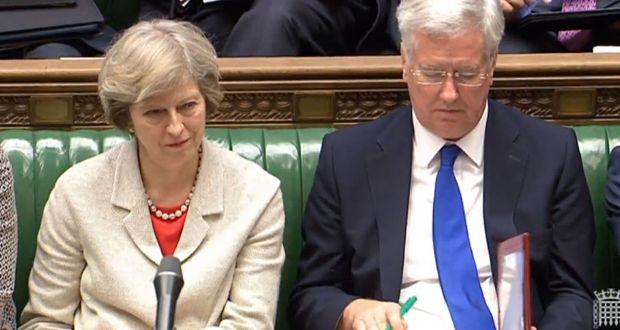
Image result for may and fallon

There’s never a good time for a feeding frenzy to break over a political system, but it is difficult to envisage many worse times for the British parliament and government than now. 

The two major parties – Conservatives and Labour – are currently trying to come to terms with their post-Brexit referendum statuses.  The Conservative minority government, meanwhile, has yet to exhibit much sureness of touch in its actual Brexit negotiations.  Add to that the natural instability that comes with a minority government, and the populist insurgency that seems to have taken over the Labour party, and you already have a febrile atmosphere in the Westminster parliament.

Into all of this has broken a new and not entirely unpredictable scandal.  It is to do with sexual harassment by MPs towards their employees and its tentacles are embracing both parties as well as having just claimed the scalp of a cabinet minister.

The origins are difficult to pinpoint.  Some suggest that the Harvey Weinstein scandal has opened the floodgates for similar revelations at Westminster.  Others point to the tawdry digital past of one of Labour’s newly elected MPs, Jared O’Mara, which last week forced the party to suspend him after a drip-feed of ever appalling revelations about his attitudes towards women in particular, all helpfully preserved on digital forums.

Wherever they originate though, British political sex scandals always seem to steer relentlessly towards the Conservative Party, and so it has proved again this time.   It didn’t take long for a spreadsheet of sin to be widely circulated amongst journalists, featuring exclusively Conservative MPs, ministers and former ministers.  Amongst the early figures to be named were junior minister Mark Garnier, for allegedly having his PA procure sex toys, and former Cabinet minister and leadership contender Stephen Crabbe, for sex-texting a 19 year old woman after interviewing her for a job. 

The spreadsheet, however, was reputed to contain some 40 named Tory MPs, and soon two senior members of the government found themselves having to respond to accusations of variable veracity.  First Secretary – and effective Deputy Prime Minister – Damian Green was accused by a former family friend of making suggestive comments to her.  He vigorously denied it and has at the time of writing instructed lawyers.  In truth, the accusations against Green – made by his accuser in a prominent article for the Times newspaper – seemed so thin as to almost disappear into the atmosphere, but it has nevertheless consumed his energies and diverted his own political energies for the past few days, as well as prompting an investigation by the Cabinet Secretary. 

The other senior Cabinet minister to be engulfed  was Defence Secretary Michael Fallon.  He placed his hand on the knee of a female acquaintance at a conference dinner 15 years ago.  The lady in question, journalist Julia Hartley-Brewer, a prominent talk radio host, soon went public to claim that the incident was fully resolved by Fallon with an apology at the time, and was of the utmost insignificance.   Bizarrely, despite this, it is Fallon who has now resigned.  In what must be the first example of Minority Report style “pre-crime” affecting politics, Fallon resigned because of possible future accusations and not over “knee-gate” as it became known.  To date, no further accusations  have been forthcoming. *
As to the 38 or so other Tory MPs on the list, whose names were redacted in published versions, several have now outed themselves on the grounds that the list contained so much fabricated material that this was the only way to discredit it effectively. 

Since this article was originally published, other accusations against Fallon have indeed been forthcoming 

This article was originally published in Vocal Europe

Monday, June 12, 2017

The post-election liberal narrative is hopelessly wrong

There seems to be a popular liberal narrative emerging about the present state of British politics which is largely summed up by (1) the Tories have got us into a mess over the past couple of years and (2) they, especially Theresa May, should apologise for getting Britain into this mess.

Utter bilge.

There may be a number of things Mrs. May needs to apologise for - a poor campaign, an overly insular leadership style, the loss of a number of Conservative seats - but all these apologies need to be directed purely at the Tory party that she leads and its candidates.  Further, an acknowledgement that she has learned lessons from the election and will seek to adapt her premiership to suit those would be helpful and politically adept.  But an apology to the country?  What a fruitless, pointless, unnecessary exercise that would be.

I presume the apology in question that liberal commentators have in mind would be along the lines of saying sorry for calling an election.  Really?  In a democracy?  The election may have been called for opportunistic and rather venal reasons, but the idea that we should somehow ration the amount of democratic engagement at the polls that the people should participate in is ludicrous and reeks of political class elitism. Mrs. May's motives in calling the election may have been ever so ignoble, but in the end she remained at the mercy of the voters.  Hubris did indeed come to rest at her door as a result, and she may wish to ponder many lessons from this, but we should not be demanding apologies from a wounded leader for the decision delivered by the people in an election.

Neither should there be an apology for calling another election in a few months if one is needed.  We are a democracy.  It is the people's right and responsibility to hire and fire their political leaders, and if that has to be done on a more regular basis until the people become satisfied with their collective decision then so be it.

There is an extraordinary feeling afoot, and it is embedded in the post-election liberal narrative, that calling elections too often is a Bad Thing.   We may be a democracy, harbouring rights that have been fought and argued for over many decades and which are still denied to the majority of people in the world, but we really shouldn't ask people to listen to political debate and hobble along to a polling booth too often.  It is the ultimate elitist nonsense, and it caters to a terrible view which suggests that we should cravenly give in to the anti-politics brigade who believe that a national political discussion shouldn't be allowed to get in the way of everyday lives to often.

This is the same view that we hear expressed about the referendum held last year which led to the Brexit process.  Now as it happens I am no fan of referendums, but I can't deny that they are the ultimate expression of the popular will on a particular issue.  It is a virtue of democracies that the popular will for change doesn't need expression in a revolution because it has a ballot box to use. 

The sub-text of much of this criticism, of course, is that the vote didn't go as liberal commentators wanted.  Rather than blame the people, however, it has become easier - though a lot more cowardly - to lay the blame at the feet of the leaders who dared engage the people in such a momentous decision.

If there is a "mess" in British politics then the responsibility lies squarely with the voters.  They have had the chance, more than they have ever had before, to direct events.  They have chosen to do so in a messy and sometimes indeterminate way.  But that is democracy, and we get the one we deserve because we are intimately involved in it.  Don't like the leaders?  Then do more than just vote.  Do more than just write well-paid columns about how bad it all is. Take some responsibility and get involved.  Stand, argue, persuade.

As it happens, I don't think the result of Thursday's election was a bad one.  It has yielded a humbled government, more willing to moderate its previously inflexible approach on Brexit, more willing to operate on a collective basis, more willing to appreciate the aims and aspirations of the voters who chose to withdraw their support.  This is what democracy should do.  The voters also, by a smidgeon, determined that they wanted the same government to continue in office.  For all his and his allies' blow-harding, Jeremy Corbyn didn't win and has no chance of forming a government with the present parliamentary make-up.  He hasn't got the numbers.  Because the voters didn't give him the numbers.  And yes, the DUP do actually count as a legitimate party.  Enough people in a part of the UK voted for them to send ten of their representatives to parliament.  They get the same rights as every other representative and that is the right, under the full scrutiny of voters who will be asked to deliver another verdict again at some point, to support or deny the biggest party its political programme.  

This isn't a "mess".  It's democracy in action and I'm sorry so many liberal commentators aren't very happy with it.  It doesn't require an apology from the prime minister.  The only people you can demand an apology from are the British electorate, and they are simply exercising the right hard won by their ancestors to nudge the government whichever way they want.  Live with it.


Saturday, June 10, 2017

Tone-deaf May is absolutely the wrong person to lead us into Brexit

If you thought Theresa May was tone-deaf and unresponsive during the actual election campaign, then that's nothing on her performance since.

Following her seriously reduced circumstances I initially thought it was right for her to continue in office.  The electoral arithmetic suggested it as the only viable option, at least until the parliamentary circumstances changed.  She could have chosen to take on board the disastrous result that her cavalier election calling produced and govern as a minority leader but with significant consultation with other parties on Brexit.  That her own Brexit stance - which has been irredeemably, if unilluminatingly of the "hard" variety - would need modifying seemed evident too.

Then came the day after.  The prime minister's speech outside Downing Street was one of the most misjudged exercises I have come across.  She made no reference at all to the lamentable election result.  She simply announced she would be forming a new government, and for good measure she replaced the old "strong and stable" with the word "certainty".  I began to wonder if somehow she had been kept isolated from the election results.  It was a performance of astonishing misjudgement and ineptitude.  Compare it with David Cameron's eloquent and moving "mea culpa" after the referendum.  So utterly disconnected was her speech that she had to follow it up with a hurriedly organised television interview in order to "apologise" to all of the Tory MPs who had lost their seats thanks to her calamitous campaign.

More than anything else, this speech captured exactly why Mrs. May must not be allowed to carry on as prime minister.  The speech bespoke an absolute determination to ignore any circumstances that don't suit her.  It shed light on Mrs. May's utter inflexibility.  Here was someone who was so myopic and incapable that she couldn't even acknowledge the earth-shaking circumstances that everyone else was talking about and which had brought her to this pass in the first place.  She couldn't move from her script.  She couldn't develop a quick response to her massively changed circumstances.  She couldn't find it within herself to express any sort of empathetic understanding to her disappointed supporters and allies.

And if she couldn't do this simple task, part of the basic toolbox of political leadership, then how on earth could we expect her to manage the infinitely more challenging unpredictable and difficult Brexit negotiations?

I thought originally that Theresa May should stay and provide some continuity in difficult times, even if those times were largely of her own creation.

Now it seems to me that if we are to have any chance of a successful start to our increasingly unwanted and unloved Brexit negotiations, then Theresa May has to be replaced immediately.  All those foolish Tories who think she will be able to open such negotiations with imagination and flexibility, who have you been listening to?  For Theresa May, alarmingly and bizarrely, "nothing has changed".  This is a woman who can row back on a policy and claim it is the same one.  That level of delusion has now been extended to some sort of weird understanding of the election that suggests it has said nothing of value to her.

The Tory Party may be in a bind because of the lack of top rate talent in its upper echelons, but at the moment almost anyone - obviously excluding Liam Fox - would be better than the delsuional, mad force currently in charge.  Instead of ringing their hands and moaning about her advisers, Tory MPs should step up to the moment and actually try and serve their country.  And they should do it by providing new and better leadership.  If they do, in time we might forgive them for the Mayist aberration.


Friday, June 09, 2017

Lessons from an election

1.  Don't take the electorate for granted.  Theresa May's party (she abdicated the Conservative name for the duration) did this twice.  It assumed everyone would ignore the opportunistic nature of the election, and that they would then happily respond to a patronising campaign of empty slogans.  Turns out they didn't.

2.  Every vote matters, even under First Past the Post.  Young voters complained about Brexit, but their complaints carried little weight given the fact that many didn't vote in that ill conceived referendum.  This time they voted, and the change has been palpable.

3.  Traditional campaigning still matters.  Theresa May's party thought they could win this with a big data machine and by programming, without variation, key phrases into the political dialogue.  They thought they could avoid real voters with impunity, whether in televised debates or in the streets.  Jeremy Corbyn suffered a media monstering, but built up support through a consistent round of old fashioned rallies.  Crowds matter, it seems, and he was able to appeal to a decent proportion of the electorate through these rallies.  We're a democracy, and he met people.  Somehow it seems to work.

4.  Manifestos should not be insulated efforts.  Whatever the fine aims of Theresa may's manifesto, it was drawn up quickly by a tight group of May loyalists who failed to road-test it within the wider party.  It then backfired.  Surprised?

5.  Leaders should be able to campaign.  As everyone is noting, this election was entirely the product of Theresa May's desire.  There was no reason at all to call it, and certainly not the one she gave.  In consequence, though, one might have expected her to show some campaigning vigour and ability.  Alas, when calculating her election gamble, she failed to factor in her own dislike of campaigning.

6.  When you have a venerable party with all its traditions and brand, use it.  Theresa May's team confined the party name to a footnote and insisted that all of her candidates do the same on their official campaign literature.  Prospective MPs once called Conservatives simply became people "standing with Theresa May".  Once the electorate decided they had their doubts about Theresa May, there wasn't anywhere else to turn.

7.  We are a parliamentary system, not a presidential one.  See 6 above and remember that for all the dominance of party leaders, constituency candidates do still stand on their own merits as well.

8.  The "vision thing" still matters.  When all was said and done, there wasn't much of a discernible vision behind the May campaign.  "Brexit means Brexit" was as empty a slogan as has ever been uttered on a campaign trail, coming as it did with absolutely no enhancing narrative or vision at all.  Compare that with Labour's ability to appeal to a range of people with a clear vision of what needed to be done for Britain.  Agree with it or not, it gave the impression they were thinking about what to offer.

9.  Personalities are important.  Theresa May would have obviously been a dominant figure even without the quasi-presidentialism of her campaign. just as Jeremy Corbyn was on the other side.  The problem for May is that she failed to project any warmth or spontaneity and appeared to actively avoid contact with ordinary voters.  In a modern democracy it isn't possible for a leader to survive without a decent skill at communications.  May utterly lacked that.  Contrast her with the cheerful and positive Ruth Davidson, leading something of a Tory revival in Scotland.

10.  Is politics being re-set?  There is a case for this.  The election has seen the return of two-party politics, the effective icing of another Scottish independence referendum, and the likelihood of a more pragmatic, Europe friendly Brexit.  Are we coming through a nightmare period, for all the veneer of chaos that exists today?

Saturday, June 03, 2017

Theresa May will be returned as a damaged prime minister

After the scares for the Conservatives of the past couple of weeks, the broad consensus is still that they will return to parliament as the biggest party in the Commons after the election - and by some margin.  Or perhaps, in Conservative campaign terminology, the emphasis should be on Theresa May returning to office as prime minister, since the party itself has had very much second billing in this campaign.

The problem with the way May and her people have decided to run the campaign is that they had no way out once it went bad.  And it did go very bad.  If you are going to relegate the actual party to a virtual afterthought, and insist that your candidates announce on their election addresses that they are "Standing with Theresa May", rather than "Standing as Conservatives", then you do need to be very sure that the product you are selling is up to the billing.  In this instance it wasn't.

While the Tories are clawing back some points in the polls, the latest Comres poll is interesting in that it graphically shows the damage the campaign has done to May's own standing.  The Conservative Party remains at 12 points ahead of Labour, but May's personal negative ratings have soared by 10 points.

Having started out with the "strong and stable" mantra, Mrs. May seems to have done everything in her power to disprove it.  Michael Crick's "weak and wobbly" accusation was seized upon by many.  A quick review of the campaign shows up the problem.  Mrs. May didn't vary from the lines she had been given from the start, causing negative comment from thinking observers and a damning belief that she was a robotic campaigner taking people for granted.  She was insulated from ordinary crowds, and when she did face them it went wrong, as in the Abingdon market square.  She avoided the televised debate and failed to provide a good or credible reason for so doing.  She put out a daring manifesto pledge which had been ill tested and then rowed back within a day once it caused upset, refusing to acknowledge that that was what she had done.  On the single issue which she claimed the election was about - Brexit - she has failed to give any information whatsoever.  No-one is any the wiser now than they were at the start of the campaign exactly what this Prime Minister's approach to Brexit, the single most important issue of the election by her own admission, is.

The Tories may still win a significant majority in the Commons, but they do so behind a seriously damaged leader, and it is almost entirely her own fault, and that of her notoriously tight team.  Many voters started the campaign with a broad belief that Theresa May was the best person to be negotiating our exit from Europe.  I doubt few hold that belief now.  The best that can be said is that she is likely to be better than Jeremy Corbyn,  although in Keir Starmer he has a putative negotiator who would wipe the floor with the likes of Liam Fox and Boris Johnson and easily hold his own with David Davis.

She didn't intend it to, but the campaign has exposed Mrs. May's shortcomings under a harsh and unforgiving light.  She will never wield the same authority after this campaign that she did before, whatever the majority.  The days when her Director of "Communications" Fiona Hill could send dismissive messages with impunity to senior ministers should be over.  If nothing else, there needs to be a sea change within Team May and at the top of government.

The two chiefs of staff need to be downgraded as soon as the new government starts.  A proper, civil service trained chief of staff needs to be appointed, and an effective Communications Director - this campaign has suffered appalling communications as well as much else.  As for the senior ministers, Philip Hammond - who has been hung out to dry by No 10 several times - should be kept on with his authority enhanced and his ability to make an independent contribution to the counsels of government kept intact.  Liam Fox, virtually invisible in the campaign and unable in any case to speak without putting his foot in his mouth, should be relieved of his duties and an able minister appointed in his place.  I would also replace Boris Johnson with a more low key and effective foreign secretary too; either move Amber Rudd (leaving space for the promotion of Damian Green, perhaps, to the Home Office) or possibly promote the well regarded Michael Fallon.  Liz Truss, incidentally, should definitely be moved away from Justice and a more rigorously independent minster put in her place - Dominic Raab perhaps, or even the return of Michael Gove who was well regarded there previously.

Sadly, that is a wish list.  Mrs. May has never been the most flexible of people and she may well not see the need to make any changes, for all the evidence of her terrible campaigning.  One thing we might consider though.  After an election such as this, will she really want to fight another in five years time?  More to the point, will the Conservative Party really want her to?


The retreat of liberalism goes on

As communism seemingly disappeared from view at the end of the 1980s, in a sudden and unexpected blow-out, there was plenty of triumphal...