Sunday, April 03, 2011
Cameron's No. 10 Operation
I have put a piece on tutor2u summarising some findings from Anthony Seldon in an excellent piece for the Independent on Sunday today. The Seldon piece is essential reading for AS students studying the power of the prime minister and the operation of the Executive in British government.


Saturday, April 02, 2011
The State of the Parties - some AS support!
Party ideology is not as fixed as it once was, and Ed Miliband faces the same problem that David Cameron faced in trying to determine how to establish a distinctive, ideologically coherent message that doesn't veer too far away from the middle-ground consensus that still decides elections.
A couple of useful support links for AS students are here:
1. From the tutor2u website, Mike McCartney gives an overview of where the parties are at the moment, using a recent sweep of relevant stories.
2. The Today programme's Norman Smith has a fascinating report on the problem for Miliband as he tries to recover lost constituencies like Gravesend, which still seem to be firmly in 'Blair country'.
A couple of useful support links for AS students are here:
1. From the tutor2u website, Mike McCartney gives an overview of where the parties are at the moment, using a recent sweep of relevant stories.
2. The Today programme's Norman Smith has a fascinating report on the problem for Miliband as he tries to recover lost constituencies like Gravesend, which still seem to be firmly in 'Blair country'.
A Tale of Two Reforms
 If you want to know whether Andrew Lansley's proposed NHS reforms are a good idea you need only take a look at the Conservative Home poll on the subject. When 84% of that site's readers agree that the reforms are necessary, you know there's a problem. Conservative Home and the Daily Telegraph compete for the readership of the core, right-wing base of the Tory Party - the same base that thought Hague, Duncan Smith and Howard were good leaders, but have real reservations over Cameron. And if they like an idea, you can bet it's probably going to go pear-shaped.
One of the key Tory perception problems - correctly identified by the Cameron team - is that they genuinely dislike public services, especially the NHS, and would like to cut them down. Margaret Thatcher, despite regularly increasing the sum given to the NHS, never quite managed to banish the impression that she'd rather privatise the whole thing. Thatcherite Tories want the NHS to be "good value for money". Well, don't we all. But many Tories think that the provision of health care can be neatly quantified, and that the only people who can do this effectively are the medically trained doctors in GP surgeries rather than the financially trained managers trying to organise the various healthcare trusts. Most Tories use private healthcare provision anyway - the sort that's properly run by business and finance aware managers whose work lets the doctors get on with their primary job of actually healing - and aren't overly bothered by the impact of reforms on the NHS. There is, I think, a sneaking suspicion that most people who use the NHS don't really need to - they're just being hypochondriacs, a bit like all the welfare cheats.
Lansley's reforms, with their odd emphasis on the wrong people managing the business side of healthcare when they should be managing the medical side of healthcare, look increasingly like a car-crash bearing down on the Coalition. Even the Conservative Homers, in their slavering desire to decapitate the NHS, also recognise that if the reforms go wrong it would be a disaster - 72% of the cuddly Conservatives apparently believe it will be hard for David Cameron to be re-elected if the reforms go wrong. Lansley's background as policy wonk and politician may not have been terribly helpful in assessing the practical problems of what he is proposing.
All of which seems to be in contrast to the under-stated but efficient way in which welfare minister Chris Grayling is now planning to radicalise the apparently often abused Incapacity Benefit. The Spectator's Fraser Nelson, one of the bash the Coalition crowd, is impressed by the way in which Grayling has gone about his task, which could substantially alter the level of Incapacity Benefits issued and increase the progress of the welfare to work reforms. Of course, Grayling benefits from the fact that welfare reform is often so complex and humdrum that no-one can be bothered to check the details, and in any case only affects a minority of the population (although 2.6 million people, the number currently on IB, is no mean minority!). The NHS potentially affects us all. But perhaps a little closer attention to detail, and the realisation that pleasing the Tory base is often a sure fire way to alienate what we might call the broader electoral base, wouldn't have gone amiss when Mr. Lansley was dotting the i's of his current grand reforms.
Monday, March 28, 2011
You Couldn't Make It Up - But Littlejohn Does, Every Week!
I must confess I've never bothered to read the Richard Littlejohn column in the Daily Mail that's enjoyed by millions, and this excellent defenestration of one of his pieces about the recent Japanese Tsunami not only confirms that it's right to give the man's malicious mutterings a wide berth, but also begs the question of how on earth he manages to continue drawing a salary for this crap. Oh, but wait a minute. His employers are the Daily Mail. Well, next time they sign his cheque, they might want to chew on these wise words of his about the appalling Rwandan genocide:
'Does anyone really give a monkey's about what happens in Rwanda? If the Mbongo tribe wants to wipe out the Mbingo tribe then as far as I am concerned that is entirely a matter for them.'
Also worth checking out this passionate, angry piece by the Independent's Johann Hari.
'Does anyone really give a monkey's about what happens in Rwanda? If the Mbongo tribe wants to wipe out the Mbingo tribe then as far as I am concerned that is entirely a matter for them.'
Also worth checking out this passionate, angry piece by the Independent's Johann Hari.
Saturday, March 26, 2011
Does Intervention in Libya Help Al-Qaeda?
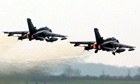 The forthright left-wing commentator Alexander Cockburn says that western intervention has never had a positive result. He may well be right. So poor is western awareness of the complexities of middle-east politics in particular that it is no wonder the interventionist tendencies of both left and right in government are more likely to come a cropper than not. Iraq was not exactly a model invasion plan, and while there may have been some self-defence justification for Afghanistan, you'd be hard put to suggest that it was an unalloyed success. So now we have Libya. It was understandable that western politicians, under pressure from their respective medias and the loud voices of interventionism, would start to see Libya as a classic case for more benevolent western military force. Gadaffi is a caricature lunatic with markedly vicious tendencies, while the besieged citizens of Benghazi are the classic heroic 'little people'. What doesn't work in this scenario?
Well, the little fact that eastern Libya is a prolific recruiting ground for al-Qaeda for one. Cockburn, in his First Post column, reports some of the alarming statistics about the closeness of Benghazi and Dernah to al-Qaeda, and concludes that Osama Bin Laden must be thinking he's living in a parallel universe as Cameron, Sarkozy, Obama et al leap to his defence.
This is the problem with rash decision making on middle-eastern politics. We may find one side unpalatable, but we know nothing about the other sides either. Libya's conflict is a civil war, and for all the tragedy of it, should have been left as such. Quite apart from the financial implications of western involvement at a time of government belt-tightening, the intervention of disliked western countries merely muddies the already murky waters of middle-eastern power struggles. And, of course, there is no exit strategy here. How could there be? We don't really know what we are fighting for. No wonder President Obama was so cautious about intervention. No wonder the US military establishment, fronted by Defence Secretary Robert Gates, was so opposed. We will see soon enough just how awkward this most recent example of western egoism is going to turn out, but the chances of this sending some lessons towards the politicians of either left or right seem slim indeed.
Monday, March 21, 2011
Cameron Fails the Palmerston Test!
Andrew Sullivan's Daily Dish is on the money as usual, although I think he under-states the genuine difficulty faced by Barack Obama. Sullivan has been blogging consistently against intervention in Libya, and here uses a historical parallel with Palmerston's refusal to take action to support the put-upon Hungarians in 1848. Sullivan uses Obama as the contemporary foil, but it works as well with the current holder of Palmerston's former office. Cameron has decided not to resist the pull of interventionism. Palmerston, the successful practitioner of 'gunboat diplomacy', did. Palmerston's historical reputation is assured. It'll be a while before the verdict on Cameron can start to be formed!
Voting For War - It's What MPs Do!
Tonight's vote in the House of Commons in favour of military action to maintain a no-fly zone over Libya was overwhelming. 557 MPs voted in favour with only 13 abstainers. It's certainly far more crushing a majority than the Iraq War vote managed back in 2003, but even that one achieved 412 to 149 in favour of action. We didn't hear a lot from the mighty 412 subsequently, and it does perhaps serve as a useful reminder that when it comes to war, MPs seem to regularly give it the benefit of the doubt. Somehow, the heartache and problems that arise from western military action can always be deferred to another day. Gaddafi's war against his rebels is a savage and unpleasant one, but the remarkable inconsistency of western foreign policy 'actions' continue to open such votes as today's to be branded as hypocritical, to say nothing of the way in which western action tends to act like quicksand on its own forces, and dimension changers on the conflicts they are designed to stop.
It is very difficult to watch Gaddafi move against the rebels without wanting to see the tables turned against him. It is also difficult to stomach Robert Mugabe pulverising, bullying and starving his own people while he remains cosseted in a lap of ill-gotten luxury. It isn't easy to hear about the violent, authoritarian action of Royal Wedding guest the King of Bahrain either, or to continue reading the gut-wrenching tales from Russia's savage, dirty war against the Chechens. When it comes to three of the afore-mentioned international calamities, the western nations appear to have tacitly - and correctly - determined that they cannot intervene. But Libya, somehow, is different. Just as Iraq was different it seems. Perhaps the presence of oil makes them different. Maybe it's simply the high media profile and the belief among so many legislators that nothing is worse than not acting upon the media's preferred crisis. There is, possibly, a strategic dimension. But whatever it is that determines the difficult to defend inconsistency of western action, nothing can disguise the continuing problem that liberal interventionism presents to a western world struggling to escape the charges of ideological imperialism that tarnishes it so badly, and the human and financial costs it so willingly incurs each time it flies in to an alien conflict.
It is very difficult to watch Gaddafi move against the rebels without wanting to see the tables turned against him. It is also difficult to stomach Robert Mugabe pulverising, bullying and starving his own people while he remains cosseted in a lap of ill-gotten luxury. It isn't easy to hear about the violent, authoritarian action of Royal Wedding guest the King of Bahrain either, or to continue reading the gut-wrenching tales from Russia's savage, dirty war against the Chechens. When it comes to three of the afore-mentioned international calamities, the western nations appear to have tacitly - and correctly - determined that they cannot intervene. But Libya, somehow, is different. Just as Iraq was different it seems. Perhaps the presence of oil makes them different. Maybe it's simply the high media profile and the belief among so many legislators that nothing is worse than not acting upon the media's preferred crisis. There is, possibly, a strategic dimension. But whatever it is that determines the difficult to defend inconsistency of western action, nothing can disguise the continuing problem that liberal interventionism presents to a western world struggling to escape the charges of ideological imperialism that tarnishes it so badly, and the human and financial costs it so willingly incurs each time it flies in to an alien conflict.
Subscribe to:
Posts (Atom)
The retreat of liberalism goes on
As communism seemingly disappeared from view at the end of the 1980s, in a sudden and unexpected blow-out, there was plenty of triumphal...

-
 As communism seemingly disappeared from view at the end of the 1980s, in a sudden and unexpected blow-out, there was plenty of triumphal...
 -
#200218907-001 / gettyimages.com George Osborne doesn’t strike me as a particularly emotive or soft-headed politician, but ev...
-
Theft is at an all time high under the Labour Party, according to distressed citizen, D. Cameron. Apparently, Mr. Cameron was wandering inn...
